Introduction
Have you ever noticed the market breaking a previous high and continuing strongly in the same direction?
Or perhaps you’ve seen a price break below a previous low and continue falling?
These movements are often referred to as a Break of Structure (BOS).
In Smart Money Concepts (SMC) and Price Action Trading, BOS is one of the most important concepts traders use to identify trend continuation and confirm market direction.
Before learning advanced concepts such as liquidity sweeps, order blocks, and fair value gaps, traders must first understand how market structure behaves. A Break of Structure helps traders determine whether buyers or sellers remain in control.
In this guide, you’ll learn what BOS means, how to identify it, why it matters, and how professional traders use it to make trading decisions.
What Is BOS in Trading?
BOS stands for Break of Structure.
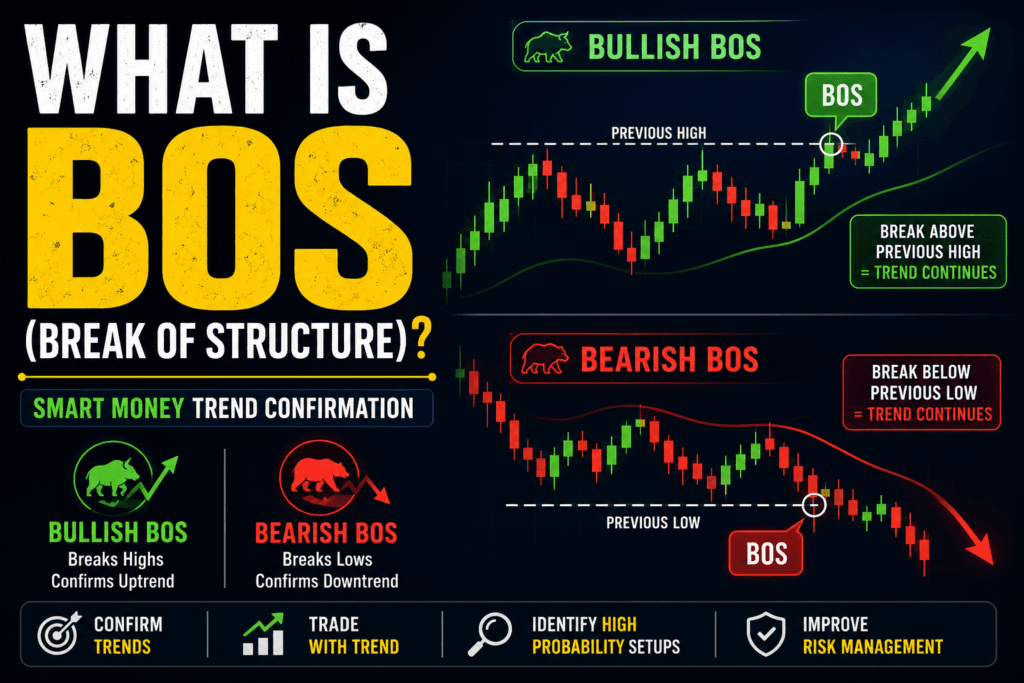
A Break of Structure occurs when price breaks a significant swing high or swing low in the direction of the existing trend.
It is considered confirmation that the current trend is likely to continue.
Simply put:
- In an uptrend, BOS occurs when the price breaks a previous swing high.
- In a downtrend, BOS occurs when the price breaks a previous swing low.
BOS signals that the dominant market participants are still controlling the trend.
Why Is BOS Important?
Break of Structure helps traders:
- Confirm trend continuation
- Avoid trading against the trend
- Improve entry timing
- Understand institutional market behavior
- Filter low-probability trades
Many traders enter positions only after a BOS confirms the trend direction.
Understanding Market Structure Before BOS
To understand BOS, you must first understand market structure.
Bullish Structure
A bullish market creates:
- Higher Highs (HH)
- Higher Lows (HL)
Example:
HH
 ↑
HL
 ↑
HH
 ↑
HL
This indicates buyers are in control.
Bearish Structure
A bearish market creates:
- Lower Highs (LH)
- Lower Lows (LL)
Example:
LH
 ↓
LL
 ↓
LH
 ↓
LL
This indicates sellers are in control.
BOS occurs when the price breaks a key swing point within these structures.
Bullish BOS Explained
A Bullish Break of Structure occurs when the price breaks above a previous swing high.
Example
Imagine:
- Price creates a Higher High.
- Price retraces and forms a Higher Low.
- Buyers return and push the price above the previous high.
This break above the previous high is called a Bullish BOS.
What Does It Mean?
It indicates:
- Buyers remain strong.
- Uptrend is likely continuing.
- Institutions may still be accumulating positions.
Many traders wait for a Bullish BOS before looking for buying opportunities.
Bearish BOS Explained
A Bearish Break of Structure occurs when the price breaks below a previous swing low.
Example
Imagine:
- Price creates a Lower Low.
- Price retraces and forms a Lower High.
- Sellers push the price below the previous low.
This break below the previous low is called a Bearish BOS.
What Does It Mean?
It indicates:
- Sellers remain dominant.
- Downtrend is likely continuing.
- Institutions may still be distributing positions.
Many traders wait for a Bearish BOS before looking for selling opportunities.
How to Identify BOS on a Chart
Step 1: Identify Market Structure
Determine whether the market is:
- Bullish
- Bearish
- Range-bound
Step 2: Mark Swing Highs and Swing Lows
Highlight significant highs and lows.
Step 3: Wait for a Break
A BOS occurs only when the price clearly breaks a significant swing point.
Step 4: Look for Confirmation
Volume, momentum, and market context can help confirm the break.
Avoid reacting to every small candle break.
BOS vs CHOCH
Many beginners confuse BOS and CHOCH.
BOS (Break of Structure)
- Confirms trend continuation.
- Occurs in the direction of the trend.
- Suggests the trend remains intact.
CHOCH (Change of Character)
- Signals a possible trend reversal.
- Occurs when market behavior changes.
- Often appears before a new trend begins.
Example
Uptrend:
HH → HL → HH
Price breaks another high:
BOS
Price later breaks a Higher Low:
CHOCH
This may indicate a shift from bullish to bearish conditions.
BOS in Smart Money Concepts
Smart Money traders use BOS to track institutional activity.
They often combine BOS with:
- Liquidity Sweeps
- Order Blocks
- Fair Value Gaps (FVG)
- CHOCH
- Market Structure
For example:
- Price sweeps liquidity.
- BOS confirms trend continuation.
- Price returns to an Order Block.
- Traders enter in the direction of the BOS.
This creates a structured trading framework.
Common BOS Trading Mistakes
Mistake 1: Trading Every Break
Not every break is a valid BOS.
Many are false breakouts.
Mistake 2: Ignoring Market Structure
BOS should always be analyzed within the overall market structure.
Mistake 3: Using Small Swing Points
Focus on significant highs and lows.
Minor fluctuations can create misleading signals.
Mistake 4: Ignoring Higher Time Frames
A BOS on a 5-minute chart may be insignificant on a 4-hour chart.
Always analyze multiple time frames.
Advantages of Using BOS
Trend Confirmation
Helps traders trade with market momentum.
Better Entries
Provides more confidence before entering trades.
Improved Risk Management
Allows traders to place stop-losses more logically.
Works Across Markets
BOS can be used in:
- Stocks
- Forex
- Commodities
- Cryptocurrencies
- Indices
Frequently Asked Questions (FAQs)
What does BOS mean in trading?
BOS stands for Break of Structure. It occurs when price breaks a significant swing high or swing low, confirming trend continuation.
Is BOS bullish or bearish?
BOS can be both bullish and bearish depending on the direction of the break.
Is BOS part of Smart Money Concepts?
Yes. BOS is one of the core concepts used in Smart Money Concepts (SMC).
What is the difference between BOS and CHOCH?
BOS confirms trend continuation, while CHOCH suggests a possible trend reversal.
Can BOS be used in all markets?
Yes. BOS works in stocks, forex, crypto, commodities, and indices.
Conclusion
Break of Structure (BOS) is one of the most important concepts in Smart Money Trading and Price Action Analysis. It helps traders identify trend continuation, understand market direction, and align themselves with institutional flow.
By combining BOS with Market Structure, Liquidity, Order Blocks, and Fair Value Gaps, traders can build a powerful framework for analyzing the market.
Remember: A BOS is not just a broken high or low. It is evidence that buyers or sellers remain in control of the market.