Introduction
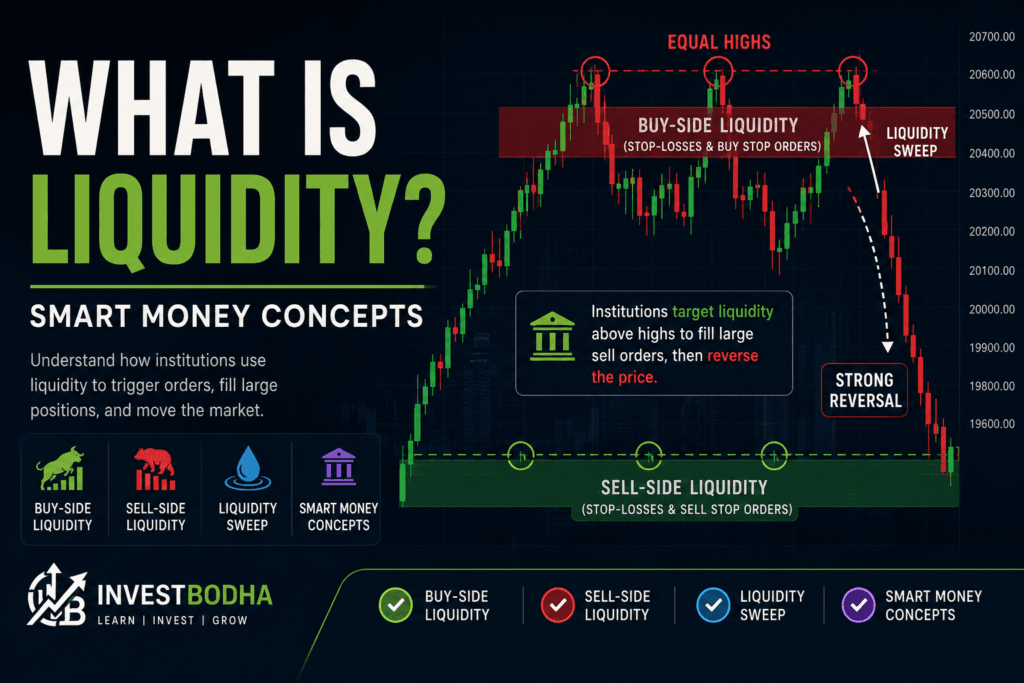
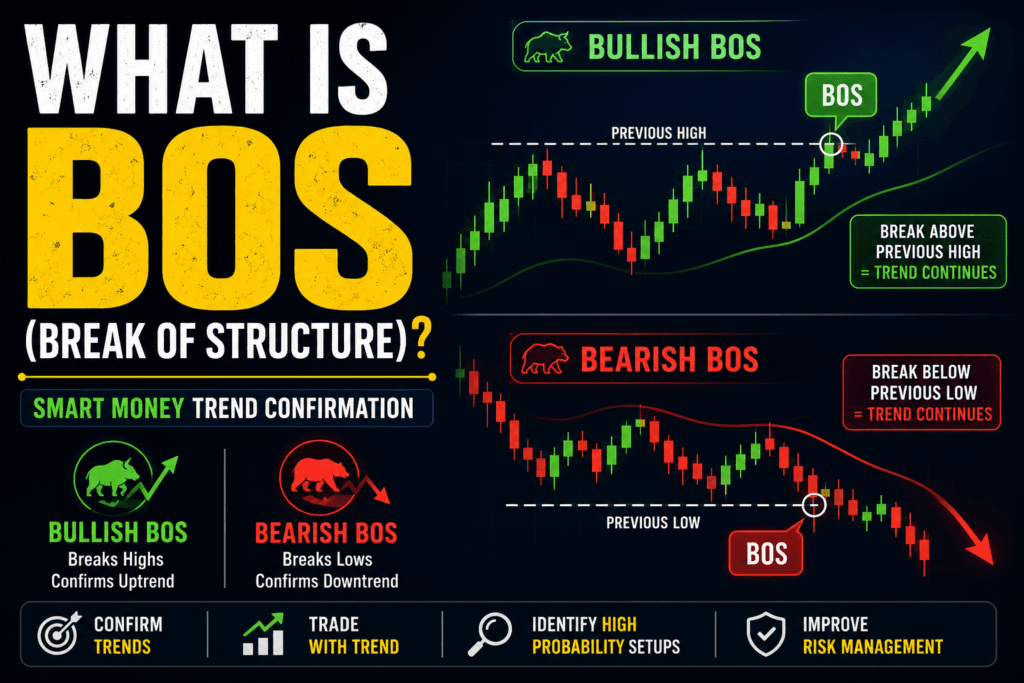
The Previous Day High & Low Trading Strategy is one of the most effective price action trading methods used by professional intraday traders. By studying how prices react around the Previous Day High (PDH) and Previous Day Low (PDL), traders can identify high-probability breakout, reversal, and trend continuation opportunities with better risk management.
The Previous Day High & Low Trading Strategy helps traders understand market strength, weakness, buying pressure, and selling pressure. When the market opens above the PDH, below the PDL, or inside the previous day’s range, each situation provides important clues about market sentiment and possible price movement.
In this guide, you will learn some of the most reliable setups used in the Previous Day High & Low Trading Strategy. We will cover bullish and bearish breakout setups, reversal trades, entry confirmation techniques, stop-loss placement, profit targets, and the market psychology behind each trading pattern.
These trading setups can be applied to stocks, forex, indices, and commodities across multiple intraday timeframes. When combined with proper discipline and risk management, the Previous Day High & Low Trading Strategy can become a powerful addition to any trader’s system.
What is the Previous Day High & Low Trading Strategy?
The Previous Day High & Low Trading Strategy is a popular intraday trading method that uses the previous trading day’s high and low levels as key support and resistance zones. Professional traders use these levels to identify breakout opportunities, reversals, fake breakouts, and trend continuation setups.
When price breaks above the previous day’s high, it often signals bullish momentum and potential buying opportunities. Similarly, when price breaks below the previous day’s low, it may indicate bearish momentum and possible selling opportunities.
Because many institutional traders and retail traders monitor these levels, the previous day’s high and low often act as important decision-making zones in the market.
Bullish Pattern: Market Opens Above Previous Day High (PDH)
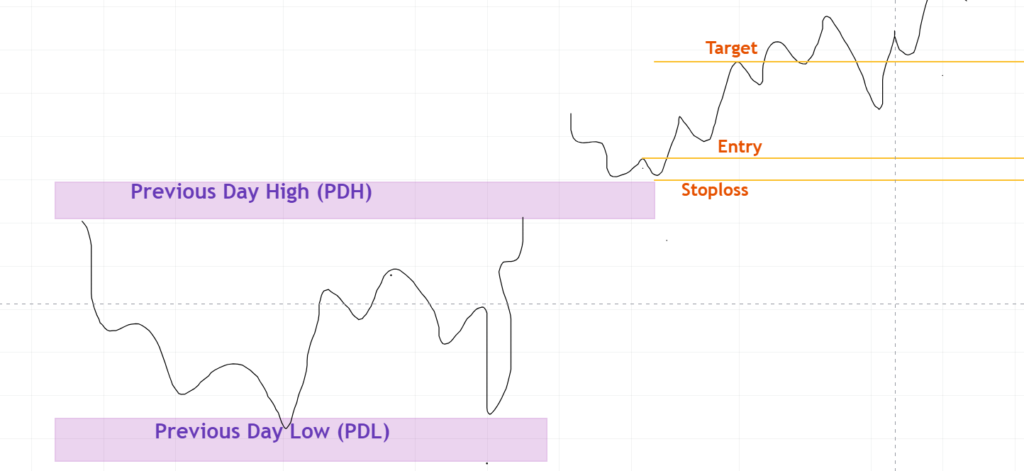
One of the strongest bullish signals in price action trading occurs when the market opens above the previous day’s high (PDH). This setup indicates that buyers are willing to pay prices higher than the previous day’s highest traded level, demonstrating strong bullish sentiment from the start of the trading session.
Professional traders closely monitor this scenario because it often signals institutional buying activity and the potential beginning of a trend continuation move. However, entering immediately after the breakout can be risky. The highest-probability trade occurs when the market retests the previous day’s high and confirms it as a support level.
When Does This Pattern Form?
This pattern forms when the market opens above the Previous Day High and maintains strength above that level.
The setup is particularly effective when:
* The previous trading session closed with bullish momentum.
* Positive news or strong market sentiment causes a gap-up opening.
* Higher time frame trends are already bullish.
* Institutional buyers are actively participating in the market.
The Previous Day High represents an area where sellers previously gained control and prevented prices from moving higher. When the market opens above this level, it suggests that buyers have successfully absorbed the available supply and are prepared to push prices higher.
Rather than chasing the initial move, experienced traders wait for a pullback toward the PDH zone. If the level holds as support and buyers step back into the market, it creates an excellent low-risk entry opportunity.
Market Psychology Behind the Setup
Understanding the psychology behind this setup helps traders execute it with greater confidence.
When the market opens above the Previous Day High, several things happen simultaneously:
Previous Sellers Are Trapped
Traders who sold near the Previous Day High, expecting resistance, are suddenly trapped in losing positions. As the market continues higher, these traders are forced to buy back their positions, creating additional buying pressure.
Breakout Traders Enter the Market
Many traders use breakout strategies and enter long positions as soon as price moves above the Previous Day High. Their buying activity contributes to upward momentum.
Institutions Accumulate Positions
Large institutions often use pullbacks to key levels for entering substantial positions. The retest of the PDH provides an ideal location for institutions to add to their long positions without chasing the market.
These combined forces create a favorable environment for a bullish continuation move.
Entry Strategy
The key to this setup is patience.
A common mistake made by inexperienced traders is entering immediately after the breakout. While this can occasionally work, it often results in poor risk-to-reward ratios and unnecessary drawdowns.
Instead, wait for the following conditions:
Entry Conditions
1. Market opens above the Previous Day High.
2. Price pulls back toward the PDH zone.
3. The Previous Day High acts as support.
4. Buyers show signs of strength through bullish price action.
5. A bullish candle closes above the support zone.
Once these conditions are met, a long position can be considered.
The retest confirms that the breakout is genuine and that buyers are defending the level.
Stop Loss Placement
Proper stop-loss placement is essential for long-term profitability.
For this setup, the stop loss should be placed below the previous day’s high zone or beneath the most recent swing low formed during the pullback.
This placement protects against false breakouts while allowing the trade sufficient room to develop.
Conservative Stop Loss
Place the stop loss below the lowest point of the pullback.
Aggressive Stop Loss
Place the stop loss slightly below the Previous Day High zone.
While the aggressive approach offers a better risk-to-reward ratio, it also increases the probability of being stopped out by normal market fluctuations.
Target Selection
Successful traders always define their profit target before entering a trade.
Several target-selection methods can be used for this setup.
Fixed Risk-to-Reward Method
Many professional traders target a minimum risk-to-reward ratio of 1:2.
For example:
* Risk = 50 points
* Target = 100 points
This approach ensures profitability even if not every trade is successful.
Market Structure Method
Another effective approach is targeting the next significant resistance level or swing high.
As the market forms new highs, traders can trail their stop loss and allow profits to run.
Trend Following Method
When strong momentum exists, traders may hold a portion of the position and trail the stop below higher lows.
This approach captures larger moves while protecting profits.
Example Trade Scenario
Imagine the previous day’s high is located at 22,000.
The market opens at 22,080, confirming bullish strength.
After the opening rally, the price retraces toward 22,000 and tests the previous day’s high.
Instead of breaking below the level, buyers step in and create a strong bullish rejection candle.
A trader enters long at 22,030.
The stop loss is placed below the pullback low at 21,980.
The risk on the trade is 50 points.
Using a 1:2 risk-to-reward ratio, the target is placed 100 points above the entry at 22,130.
As buyers continue driving the market higher, the target is eventually achieved.
This scenario demonstrates how waiting for confirmation can significantly improve trade quality and reduce risk.
Advantages of This Setup
The bullish breakout and retest setup offers several benefits:
* Clear entry criteria.
* Logical stop-loss placement.
* Excellent risk-to-reward opportunities.
* Suitable for stocks, forex, indices, and commodities.
* Aligns with institutional trading behavior.
* Easy to identify on intraday charts.
Because the setup is based on objective market structure rather than indicators, it can be applied across different market conditions and timeframes.
Common Mistakes to Avoid
Many traders fail to maximize this setup because they make avoidable mistakes.
Chasing the Breakout
Entering immediately after a strong breakout often results in poor entries and emotional decision-making.
Ignoring Confirmation
A breakout is not valid simply because the price moves above PDH. The level must hold as support.
Moving Stop Losses
Expanding stop losses after entering a trade can quickly turn manageable losses into significant account damage.
Taking Low-Quality Setups
Not every breakout above the Previous Day High leads to continuation. Focus on setups with clear structure and strong price action confirmation.
Key Takeaway
The Bullish Previous Day High breakout strategy is one of the most reliable price-action setups available to traders. By waiting for the market to open above the Previous Day High and then retest the level as support, traders can participate in strong bullish moves while maintaining controlled risk.
The combination of trapped sellers, breakout buyers, and institutional participation often creates powerful continuation opportunities. With disciplined execution, proper stop-loss placement, and a favorable risk-to-reward ratio, this setup can become a valuable addition to any trader’s strategy.
Bearish Pattern: Market Opens Below Previous Day Low (PDL)
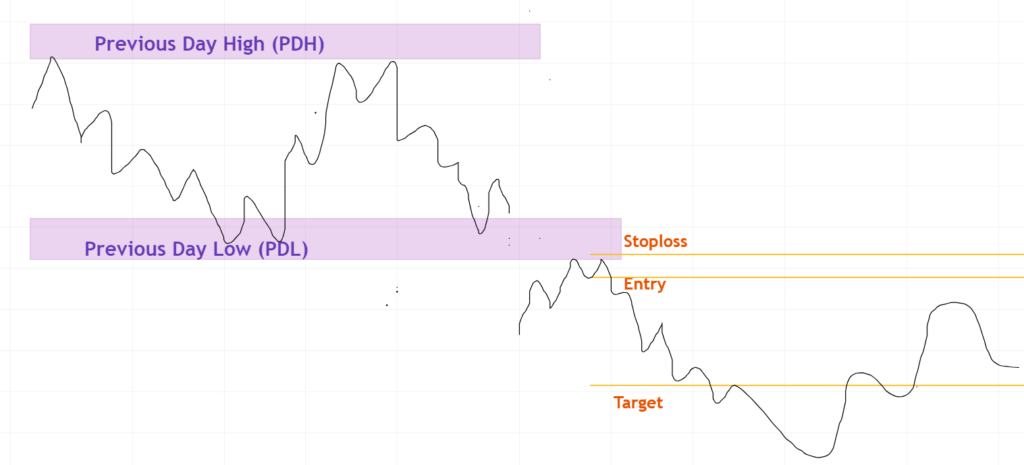
The bearish counterpart of the Previous Day High breakout strategy occurs when the market opens below the Previous Day Low (PDL). This setup is widely used by professional traders because it signals weakness in the market and often leads to strong downside momentum.
When the price opens below the previous day’s low, it indicates that sellers have gained control and are willing to trade at prices lower than the previous day’s lowest level. This shift in sentiment can trigger panic selling, stop-loss hunting, and fresh short positions, creating an environment where price can decline rapidly.
However, the highest-probability trading opportunity does not occur immediately after the breakdown. Instead, experienced traders wait for the market to retest the previous day’s low from below and confirm it as a resistance level before entering a short position.
When Does This Pattern Form?
This pattern develops when the market opens below the Previous Day Low and fails to reclaim that level.
The setup is most effective under the following conditions:
* The broader market trend is bearish.
* Negative news or weak sentiment creates a gap-down opening.
* Sellers dominate the opening session.
* Higher time frame structure supports further downside movement.
The Previous Day Low represents a level where buyers previously managed to defend price. When the market opens below this level, it suggests that buyers have lost control and sellers are becoming increasingly aggressive.
After the initial breakdown, the price often retraces back toward the previous day’s low. If sellers successfully defend the level and prevent buyers from pushing above it, the market frequently resumes its downward trend.
This retest creates a low-risk and high-probability entry opportunity.
Market Psychology Behind the Setup
Understanding what is happening behind the scenes can significantly improve trade execution.
Previous Buyers Become Trapped
Many traders buy near the previous day’s low, expecting the area to act as support.
When the price opens below this level, those buyers suddenly find themselves in losing positions. As the market continues lower, they are forced to exit their trades, adding more selling pressure.
Breakdown Traders Enter the Market
Many traders specifically look for breakdowns below important support levels.
The break below PDL attracts fresh short sellers who expect further downside movement.
Institutional Selling Activity
Large institutions often use pullbacks toward key resistance zones to build or add to short positions.
The retest of the Previous Day Low provides an ideal location for institutions to sell without chasing price lower.
Together, trapped buyers, new sellers, and institutional participation create a strong bearish environment.
Entry Strategy
Patience is critical when trading this setup.
One of the biggest mistakes traders make is entering immediately after the breakdown.
While momentum may initially continue downward, entering after an extended move often leads to poor entries and unfavorable risk-to-reward ratios.
Instead, wait for confirmation.
Entry Conditions
1. Market opens below the Previous Days Low.
2. Price retraces back toward the PDL zone.
3. The Previous Day Low acts as resistance.
4. Bearish price action appears near the level.
5. A bearish candle closes below resistance.
Once these conditions are satisfied, a short position can be considered.
The retest confirms that sellers remain in control and that the breakdown is valid.
Stop Loss Placement
Risk management is a crucial component of every trading strategy.
For this setup, the stop loss should be positioned above the previous day’s low zone or above the recent swing high formed during the retracement.
This location protects the trade if buyers successfully reclaim the level and invalidate the bearish setup.
Conservative Stop Loss
Place the stop loss above the highest point of the retracement.
This provides additional protection against market noise and false breakouts.
Aggressive Stop Loss
Place the stop loss just above the Previous Day Low zone.
Although this improves the risk-to-reward ratio, it also increases the chance of being stopped out prematurely.
Traders should choose a stop-loss method that matches their risk tolerance and trading style.
Target Selection
A well-defined target is essential for consistent trading performance.
Several methods can be used to determine profit targets.
Fixed Risk-to-Reward Target
Many professional traders use a minimum risk-to-reward ratio of 1:2.
For example:
* Risk = 40 points
* Target = 80 points
This approach helps maintain long-term profitability even if some trades fail.
Support-Based Target
The next significant support zone can serve as a logical profit target.
This method aligns the trade with market structure and often improves target accuracy.
Trend Continuation Target
In strongly bearish markets, traders may trail their stop loss above lower highs and allow the trend to continue.
This approach maximizes profit potential during high-momentum selling sessions.
Example Trade Scenario
Assume the Previous Day Low is located at 21,500.
The market opens at 21,430, confirming bearish strength.
Shortly after the open, the price retraces toward 21,500 and tests the previous day’s low from below.
Buyers attempt to reclaim the level but fail.
A bearish rejection candle forms, and sellers immediately regain control.
A trader enters a short position at 21,470.
The stop loss is placed above the retracement high at 21,520.
The total risk on the trade is 50 points.
Using a 1:2 risk-to-reward ratio, the trader sets a target 100 points below the entry at 21,370.
As selling pressure increases throughout the session, the price reaches the target, and the trade is completed.
This example highlights the importance of waiting for confirmation rather than chasing the initial breakdown.
Advantages of This Setup
The Previous Day Low breakdown strategy remains popular among professional traders because of its simplicity and effectiveness.
Key advantages include:
* Clearly defined entry conditions.
* Logical stop-loss placement.
* Excellent risk-to-reward opportunities.
* Works across stocks, forex, indices, and commodities.
* Aligns with institutional selling behavior.
* Easy to identify on multiple timeframes.
Because the setup is based on pure price action, it can be applied in virtually any liquid market.
Common Mistakes to Avoid
Even strong setups can fail when traders make avoidable errors.
Selling the Initial Breakdown
Entering after a large bearish candle often results in poor trade location.
Waiting for a retest usually provides a better entry and lower risk.
Ignoring the Retest
The retest is the confirmation that sellers are defending the previous day’s low.
Skipping this step increases the probability of trading a false breakdown.
Poor Stop-Loss Placement
Stops that are too tight often get triggered by normal market fluctuations.
Always place the stop in a logical location beyond the market structure.
Trading Against Higher Time Frame Trends
The setup generally performs better when it aligns with the broader market direction.
Trading against strong higher time frame support can reduce the probability.
Key Takeaway
The Bearish Previous Day Low breakdown strategy is a powerful price-action setup that allows traders to capitalize on market weakness. When the market opens below the Previous Day Low and later retests the level as resistance, it creates a high-probability opportunity for a short trade.
The combination of trapped buyers, aggressive sellers, and institutional participation often fuels strong downward momentum. By waiting for confirmation, placing stop losses logically, and maintaining favorable risk-to-reward ratios, traders can use this setup to identify consistent bearish trading opportunities across a wide range of financial markets.
Bullish Pattern: Market Opens Within Previous Day Range (PDH–PDL)
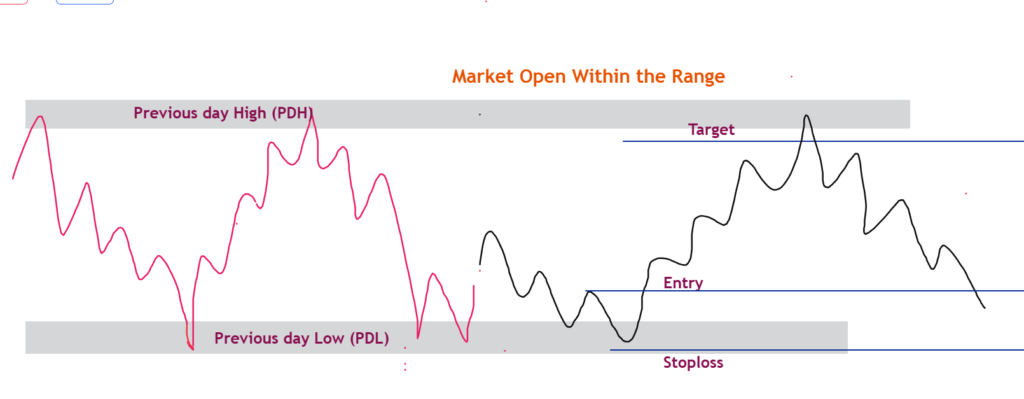
One of the most reliable bullish reversal setups in price action trading occurs when the market opens between the **Previous Day High (PDH)** and **Previous Day Low (PDL)**. This setup indicates that the market has opened inside the previous session’s range and is waiting for directional confirmation.
Professional traders closely observe this situation because it often creates high-probability trading opportunities near important support and resistance zones. Instead of chasing price movement in the middle of the range, experienced traders wait for the market to test the **Previous Day Low (PDL)** and look for bullish confirmation before entering a trade.
The highest-probability setup occurs when price approaches the Previous Day Low, fails to break lower, and then reverses strongly upward as buyers regain control.
When Does This Pattern Form?
This pattern forms when the market opens inside the previous day’s trading range.
The setup becomes highly effective when:
* The market opens between PDH and PDL.
* Price gradually moves toward the previous day’s low support zone.
* Sellers fail to break below the support area.
* Buyers step in aggressively near PDL.
* The higher time frame trend remains bullish.
The Previous Day Low acts as a strong support level because it represents the area where buyers previously defended the price successfully.
When the market retests this level and holds above it, it often signals that buyers are still in control and preparing for another upward move.
Rather than entering randomly inside the range, disciplined traders wait for price confirmation near support before taking positions.
Market Psychology Behind the Setup
Understanding the psychology behind this setup helps traders execute it with greater confidence and discipline.
When the market opens inside the previous day’s range, several important things occur simultaneously:
Buyers and Sellers Are Initially Neutral
The opening inside the range indicates a temporary balance between buyers and sellers. The market has not yet established a strong directional bias.
Previous Day Levels Become Key Decision Areas
Institutional traders pay close attention to the previous day’s high and low because these levels often influence intraday market direction.
* PDH acts as resistance.
* PDL acts as support.
Weak Sellers Get Trapped Near Support
As the price approaches the Previous Day Low, many traders attempt to sell in anticipation of a breakdown.
However, if the market fails to sustain below PDL and quickly reverses upward, those sellers become trapped and are forced to exit their positions.
This creates additional buying pressure and helps fuel the bullish move.
Institutions Use Pullbacks for Entries
Large market participants often prefer entering during pullbacks rather than chasing prices higher.
The retest of the previous day’s low provides institutions with an ideal low-risk accumulation zone.
These combined factors create favorable conditions for a bullish reversal and continuation move.
Entry Strategy
Patience is the most important part of this setup.
Many inexperienced traders make the mistake of entering trades in the middle of the range, where price action is often random and unpredictable.
Instead, traders should wait for the price to approach the previous day’s low and show clear signs of bullish strength.
Entry Conditions
1. Market opens within the Previous Day High and Previous Day Low range.
2. Price moves toward the previous day’s low support zone.
3. Sellers fail to break below PDL.
4. Bullish rejection or reversal price action appears.
5. Strong bullish candles confirm buyer strength.
6. Entry is taken after confirmation above the short-term resistance.
Once these conditions are satisfied, a long position can be considered.
The confirmation helps traders avoid false breakdowns and improves the overall probability of success.
Stop Loss Placement
Proper stop-loss placement is essential for managing risk effectively.
For this setup, the stop loss should be placed below the previous day’s low or below the recent swing low created during the reversal.
This placement protects traders if the support level fails and the market breaks down.
Conservative Stop Loss
Place the stop loss below the lowest wick formed near the PDL support area.
Aggressive Stop Loss
Place the stop loss slightly below the Previous Day Low zone.
While the aggressive approach offers a better risk-to-reward ratio, it also increases the chance of getting stopped out due to normal market volatility.
Target Selection
Successful traders always define profit targets before entering a trade.
Several target-selection methods can be used for this setup.
Fixed Risk-to-Reward Method
Professional traders commonly use a minimum 1:2 risk-to-reward ratio.
For example:
* Risk = 40 points
* Target = 80 points
This ensures long-term profitability even if some trades fail.
Resistance-Based Target
Another effective method is targeting:
* Mid-range resistance
* Intraday swing highs
* Previous Day High area
In this setup, the target is positioned near the upper resistance zone inside the range.
Trend Continuation Method
If bullish momentum remains strong, traders may trail stop losses below higher lows and allow profits to continue running.
This method helps capture larger trending moves.
Example Trade Scenario
Assume the Previous Day High is located at 22,500 and the Previous Day Low is located at 22,000.
The market opens at 22,180, remaining inside the previous day’s range.
During the opening session, the price slowly declines toward the previous day’s low support area.
As price tests 22,000, sellers attempt a breakdown but fail to push the market lower.
A strong bullish rejection candle forms near the support zone.
A trader enters a long position at 22,060 after bullish confirmation.
The stop loss is placed below the swing low at 21,980.
The total risk on the trade is 80 points.
Using a 1:2 risk-to-reward ratio, the target is placed 160 points above the entry near 22,220.
As buying momentum increases, the market rallies upward and eventually reaches the target.
This example demonstrates how waiting for support confirmation can significantly improve trade quality and reduce unnecessary risk.
Advantages of This Setup
The bullish Previous Day Range setup offers several important advantages:
* Clear support and resistance structure.
* Logical stop-loss placement.
* Strong risk-to-reward opportunities.
* Suitable for stocks, forex, indices, and commodities.
* Reduces emotional decision-making.
* Aligns with institutional trading behavior.
* Easy to identify on intraday charts.
Because the strategy is based on price structure rather than indicators, it remains effective across different market conditions and timeframes.
Common Mistakes to Avoid
Many traders fail to maximize this setup because they ignore important trading principles.
Trading in the Middle of the Range
The middle area often contains random price movement and low-probability trades.
Entering Without Confirmation
A support level is not valid simply because the price touches it. Buyers must clearly defend the zone.
Ignoring Stop Losses
Failing to manage risk properly can quickly lead to large trading losses.
Forcing Trades
Not every range-bound opening produces a quality setup. Traders should focus only on clear and structured opportunities.
Key Takeaway
The Bullish Previous Day Range strategy is one of the most reliable price-action setups for intraday trading. By waiting for the market to open within the previous day’s range and then retest the previous day’s low as support, traders can participate in strong bullish reversals while maintaining controlled risk.
The combination of trapped sellers, institutional buying activity, and a clear market structure often creates excellent continuation opportunities. With disciplined execution, proper stop-loss placement, and favorable risk-to-reward management, this setup can become a valuable addition to any trader’s strategy.
Bearish Pattern: Market Opens Within Previous Day Range (PDH–PDL)
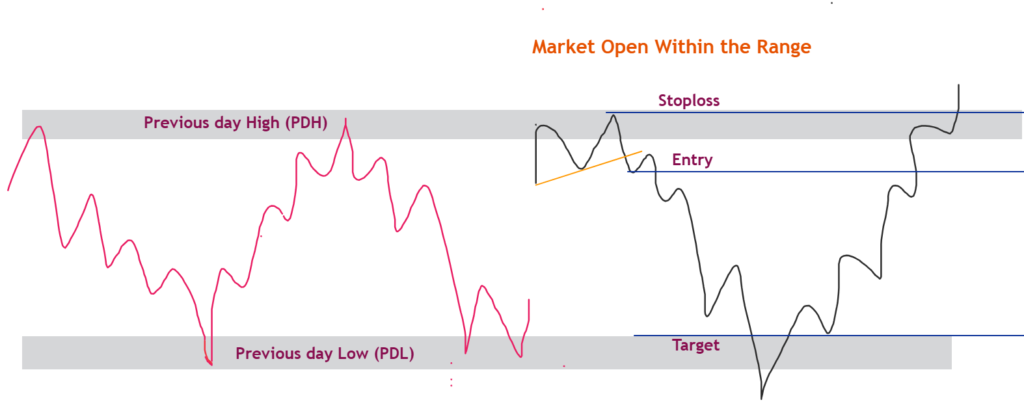
One of the most powerful bearish intraday trading setups occurs when the market opens between the **Previous Day High (PDH)** and **Previous Day Low (PDL)** and fails to sustain near the upper resistance zone. This setup signals weakness inside the range and creates an excellent opportunity for a bearish reversal trade.
Professional traders closely monitor this scenario because it often traps aggressive buyers near resistance before the market reverses sharply downward. Instead of selling immediately after the market opens, experienced traders wait for confirmation near the **Previous Day High (PDH)** before entering a short position.
The highest-probability setup occurs when the price approaches the previous day’s high, fails to break higher, and then starts moving downward with strong bearish momentum.
When Does This Pattern Form?
This pattern forms when the market opens inside the previous day’s range and begins trading near the upper resistance zone.
The setup becomes highly effective when:
* The market opens between PDH and PDL.
* Price moves toward the previous day’s high resistance area.
* Buyers fail to sustain above PDH.
* Bearish price action appears near resistance.
* Sellers regain control with strong downward momentum.
The Previous Day High acts as a major resistance zone because it represents the area where sellers previously stopped the market from moving higher.
When price retests this level and fails to break above it, it often signals that sellers are defending the zone aggressively.
Disciplined traders avoid selling in the middle of the range and instead wait patiently for confirmation near resistance.
Market Psychology Behind the Setup
Understanding the psychology behind this setup helps traders identify high-probability bearish reversals.
When the market opens inside the previous day’s range, the market initially remains neutral. However, as price approaches the Previous Day High, several important things happen.
Buyers Become Overconfident
Many traders assume that the price will break above the previous day’s high and continue higher.
As a result, breakout buyers enter long positions near resistance.
Smart Money Sells Near Resistance
Professional traders and institutions often use resistance retests to enter short positions rather than chasing the price lower.
The Previous Day High provides an ideal low-risk selling area.
Breakout Buyers Become Trapped
When the price fails to break above resistance and reverses downward, buyers who entered near the highs become trapped.
As they exit their positions, additional selling pressure enters the market and accelerates the bearish move.
These combined forces create strong downside momentum.
Entry Strategy
Patience and confirmation are essential for this setup.
Many inexperienced traders make the mistake of entering short positions too early, before bearish confirmation appears.
Instead, traders should wait for clear weakness near the previous day’s high zone.
Entry Conditions
1. Market opens within the Previous Day High and Previous Day Low range.
2. Price moves toward the previous day’s high resistance zone.
3. Buyers fail to sustain above PDH.
4. Bearish rejection or reversal price action appears.
5. Sellers regain momentum with strong bearish candles.
6. Entry is taken after confirmation of short-term support.
Once these conditions are satisfied, a short position can be considered.
The confirmation helps traders avoid false reversals and improves trade quality.
Stop Loss Placement
Risk management is critical for long-term trading success.
For this setup, the stop loss should be placed above the previous day’s high or above the recent swing high formed during the reversal.
This protects traders if the resistance level breaks and the market continues higher.
Conservative Stop Loss
Place the stop loss above the highest wick formed near the PDH resistance zone.
Aggressive Stop Loss
Place the stop loss slightly above the Previous Day High.
While the aggressive approach improves the risk-to-reward ratio, it also increases the probability of getting stopped out by temporary volatility.
Target Selection
Successful traders always define their targets before entering a trade.
Several methods can be used for this setup.
Fixed Risk-to-Reward Method
Professional traders commonly target a minimum 1:2 risk-to-reward ratio.
For example:
* Risk = 50 points
* Target = 100 points
This ensures long-term profitability even if some trades fail.
Support-Based Target
Another effective method is targeting:
* Mid-range support
* Intraday swing lows
* Previous Day Low zone
In this setup, the target is positioned near the lower support area inside the range.
Trend Continuation Method
If bearish momentum remains strong, traders may trail stop losses above lower highs and hold positions for larger downside moves.
This approach helps maximize profits during trending markets.
Example Trade Scenario
Assume the Previous Day High is located at 22,500 and the Previous Day Low is located at 22,000.
The market opens at 22,320, remaining inside the previous day’s range.
During the opening session, the price gradually moves upward toward the previous day’s high resistance zone.
As price tests 22,500, buyers attempt a breakout but fail to sustain above resistance.
A strong bearish rejection candle forms near the PDH zone.
A trader enters a short position at 22,420 after bearish confirmation.
The stop loss is placed above the swing high at 22,520.
The total risk on the trade is 100 points.
Using a 1:2 risk-to-reward ratio, the target is placed 200 points lower near 22,220.
As selling momentum increases, the market declines sharply and eventually reaches the target.
This example demonstrates the importance of waiting for confirmation instead of emotionally chasing trades.
Advantages of This Setup
The bearish Previous Day Range setup offers several important advantages:
* Clear resistance and support structure.
* Logical stop-loss placement.
* Strong risk-to-reward opportunities.
* Suitable for stocks, forex, indices, and commodities.
* Reduces emotional trading decisions.
* Aligns with institutional trading behavior.
* Easy to identify on intraday charts.
Because the strategy is based on market structure and price action rather than indicators, it remains effective across different timeframes and market conditions.
Common Mistakes to Avoid
Many traders fail to maximize this setup because they ignore discipline and confirmation.
Selling in the Middle of the Range
The middle area often contains random price movement and low-probability setups.
Entering Without Confirmation
Resistance levels must show clear selling pressure before entry.
Ignoring Risk Management
Failing to use proper stop losses can lead to large and unnecessary trading losses.
Forcing Trades
Not every market opening inside the range produces a valid bearish setup. Focus only on clean and structured opportunities.
Key Takeaway
The Bearish Previous Day Range strategy is one of the most reliable price-action setups for intraday trading. By waiting for the market to open within the previous day’s range and then retest the previous day’s high as resistance, traders can participate in strong bearish reversals while maintaining controlled risk.
The combination of trapped buyers, institutional selling activity, and a clear market structure often creates excellent downside opportunities. With disciplined execution, proper stop-loss placement, and favorable risk-to-reward management, this setup can become a valuable addition to any trader’s trading strategy.
Tradingview link – https://www.tradingview.com/